The Sedgwick Pie: An Historical Slice
“The graveyard is a club. A club of the dead, to be sure, but it is a club.”
The winding paths of Stockbridge Cemetery in the Berkshires of Massachusetts lead visitors through a chronicle of American history, but perhaps no spot tells a more compelling story than the curious burial arrangement known as “The Sedgwick Pie.” This remarkable burial ground embodies the hierarchical structure of early American society while telling the story of a family whose legacy spans from Revolutionary War politics to 1960s counterculture. The Pie includes abolitionists and authors, figures whose influence shaped both societies children and the culture of things.
I discovered this historical treasure through an unlikely source, my teenage fascination with Andy Warhol’s Factory scene and its ill-fated “poor little rich girl,” Edie Sedgwick (1943-1971). I did not visit the burial ground until I was in my 40s. It sits just off Main Street in Stockbridge, reached by a path lined with tall spruce trees. The Pie is nested within a ring of evergreens. From the site, you can see the private farm next door beneath the Naumkeag Estate. Once you find the Pie. Once you find the pie, you’ll know it.
As a high school student, I was captivated when Edie's name appeared in multiple songs across different musical genres from artists I was passionate about then. What was it about this woman that inspired so many artists simultaneously, creating works that resonated widely enough to find mainstream success? My curiosity led me to Jean Stein and George Plimpton's biography about her which unexpectedly served as my first deep dive into American family history. The giant work presents the family history as remembered by family members. Direct quotes are assembled in like fashion for each chapter. “Edie: An American Biography” was probably the first time I had ever seen a genealogical drop chart. I didn’t know anything about my family beyond my immigrant grandparents growing up. Sometimes ancestral knowledge is for a more established and advantaged class.
What began as my fascination with pop culture references unexpectedly opened a doorway to American history, demonstrating how our past continuously informs our present, often in ways we least expect. For anyone interested in American history, cultural transitions, or simply beautiful historic cemeteries, the Sedgwick Pie at Stockbridge Cemetery offers a profound and moving experience connecting personal stories to our collective experience.
Edie’s life was a departure from her heritage so drastic that she appears as the famous black sheep from a long line of colonial American power. She was a descendant of the Cabot, Peabody (and of course Endicott), Dwight, de Forest, Pinchot, Stokes, Minturn and Shaw dynasties. Her ancestors had their portraits painted by John Singer Sargent (1856-1925), Gilbert Stuart (1755-1828); displayed in the most esteemed art museums in America. The Sedgwicks are an American dynasty whose influence stretched across politics, law, literature, and society since the country's founding. Their family burial ground, the "Sedgwick Pie", is a circular arrangement where family members rest in concentric rings around patriarch Judge Theodore Sedgwick (1746-1813), a former Speaker of the House and U.S. Senator. The plots are arranged in concentric circles around a central point, with the dead grouped by family and laid to rest with their feet turned inward. This arrangement departs from the rest of the cemetery, where graves follow the traditional eastward orientation, toward the rising sun, Jerusalem, and the promise of Resurrection. But Edie is not buried there. She took a different path and because of this she was forced down that path. She’s buried in Oak Hill Cemetery in Ballad near Santa Barbara California where she grew up.
The Sedgwick Pie offers a unique lens through which to view American history, a continuous narrative from the nation's founding through its various cultural revolutions. Standing in this peaceful corner of the Berkshires, visitors can trace the evolution of American society through a single family's lineage, culminating with Edie, whose brief but brilliant life captured a moment of tremendous cultural transformation.
Standing there, you realize it’s less about death than identity: how families organize themselves, how power reproduces itself, and what the cost can be.
Milton Bass, “Resting content in ‘The Sedgwick Pie’ “, The Berkshire Eagle (Pittsfield, Mass.), Jun 18, 1989, p.80.
Jean Stein, George Plimpton, ed., Edie: An American Biography (New York: Alfred A. Knopf, 1982)
Chris White “Exploring our literary roots”, North Adams Transcript (North Adams, Mass.), Jun 23, 2005, p. 30.
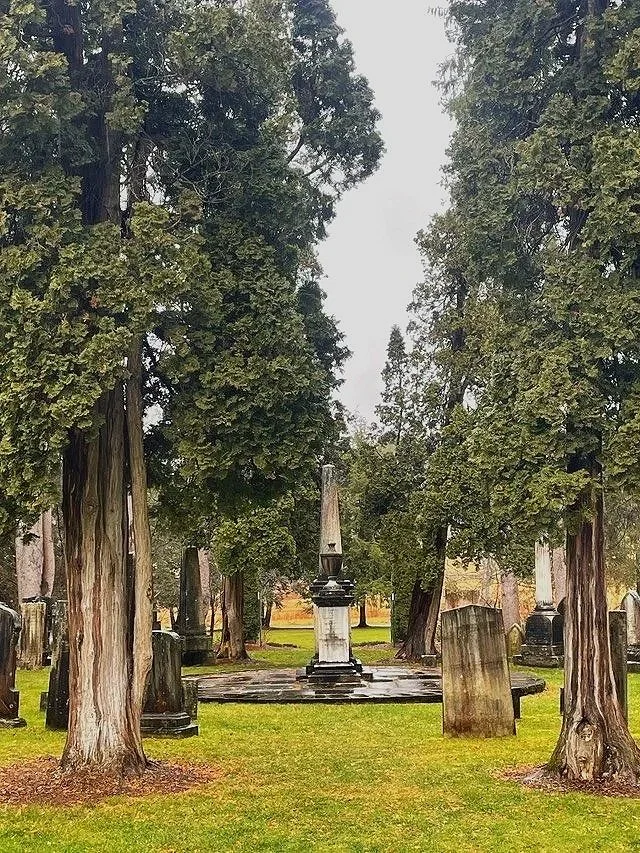
The Sedgwick family burial plot, known as the “Sedgwick Pie,” Stockbridge Cemetery, Massachusetts. Arranged in concentric circles around Judge Theodore Sedgwick (1746–1813), the monument offers a striking visual expression of lineage, hierarchy, and continuity in early American elite families; demonstrating that even in death, some families preferred to remain well-organized, inward-facing, and firmly centered on themselves.
“Have you ever sen the old graveyard up there in Stockbridge? In one corner is the family’s burial place; it’s called the Sedgwick Pie. The Pie is rather handsome. In the center Judge Theodore Sedgwick, the first of the Stockbridge Sedgwicks and a great-great grandfather of Edie’s…, is buried under his tombstone, a high rising obelisk, and his wife Pamela is beside him. They are like the king and queen on a chessboard and all around them like a pie are more modest stones, put in layers, back and round in a circle. The descendants of Judge Sedgwick, from generation unto generation, are all buried with their heads facing out and their feet pointing in toward their ancestor. The legend is that on Judgement Day when they arise and face the Judge, they will have to see no one but Sedgwicks. Judge Sedgwick moved to Stockbridge right after the Revolution….Anybody who is a descendant of the Judge may be buried in teh Pie. but at the Judge’s feet. lies a woman named Elizabeth Freeman, known to the family as Mumbet. She is supposed to have been teh first freed slave in the Commonwealth of Massachusetts. The story goes that she happened to hear the Declaration of Independence rad aloud at a town meeting. I recall reports that Mumbet’s owner treated her cruelly…. She ran away and sought out Judge Sedgwick and said “Sir I heard that we are all born equal and every on of us has the right to be free” and Judge Sedgwick was so impressed that he argued for her freedom. Mumbet stayed with him in gratitude for the rest of her life. - John P. Marquand, Jr. from Edie: An American Biography, p. 3.
